
Dolnośląska Biblioteka Cyfrowa udostępnia 110 146 obiektów cyfrowych
Obiekt
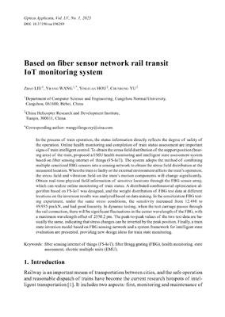
Tytuł: Based on fiber sensor network rail transit IoT monitoring system
Autor:
Liu, Zhao ; Wang, Yifang ; Hou, Yingjuan ; Yu, Chunrong
Współtwórca:
Opis:
Optica Applicata, Vol. 55, 2025, nr 1, s. 5-17 ; Optica Applicata is an international journal, published in a non-periodical form in the years 1971-1973 and quarterly since 1973. From the beginning of the year 2008, Optica Applicata is an Open Access journal available online via the Internet, with free access to the full text of articles serving the best interests of the scientific community. The journal is abstracted and indexed in: Chemical Abstracts, Compendex, Current Contents, Inspec, Referativnyj Zhurnal, SCI Expanded, Scopus, Ulrich’s Periodicals Directory ; kliknij tutaj, żeby przejść
Abstrakt:
Wydawca:
Oficyna Wydawnicza Politechniki Wrocławskiej
Miejsce wydania:
Data wydania:
Typ zasobu:
Identyfikator zasobu:
doi:10.37190/oa/196289 ; oai:dbc.wroc.pl:139704
Źródło:
<sygn. PWr A3481II> ; kliknij tutaj, żeby przejść ; kliknij tutaj, żeby przejść
Język:
Powiązania:
Optica Applicata ; Optica Applicata, Vol. 55, 2025 ; Optica Applicata, Vol. 55, 2025, nr 1 ; Politechnika Wrocławska. Wydział Podstawowych Problemów Techniki
Prawa:
Wszystkie prawa zastrzeżone (Copyright)
Prawa dostępu:
Dla wszystkich w zakresie dozwolonego użytku
Lokalizacja oryginału:
Tytuł publikacji grupowej:
Kolekcje, do których przypisany jest obiekt:
- Dolnośląska Biblioteka Cyfrowa > Uczestnicy Konsorcjum > 01. Politechnika Wrocławska > Czasopisma > Wydane w PWr > Optica Applicata
- Dolnośląska Biblioteka Cyfrowa > Zasoby > 2. Czasopisma > Czasopisma współczesne
- Dolnośląska Biblioteka Cyfrowa > Dziedziny nauki > 6. Nauki ścisłe i przyrodnicze
Data ostatniej modyfikacji:
6 lis 2025
Data dodania obiektu:
26 sie 2025
Liczba wyświetleń treści obiektu:
71
Wszystkie dostępne wersje tego obiektu:
https://dlibra.kdm.wcss.pl/publication/178518
Wyświetl opis w formacie RDF:
Wyświetl opis w formacie OAI-PMH:
| Nazwa wydania | Data |
|---|---|
| Based on fiber sensor network rail transit IoT monitoring system | 6 lis 2025 |
Obiekty Podobne
Guodan, Sun Rong, Wang Tao, Pu Zhihu, Wei Jintian, Xiong
Zheng, Jilin Wang, Rong Pu, Tao Lu, Lin Fang, Tao Su, Yang Li, Ling Yang, Qian Chen, Xiangfei Urbańczyk, Wacław. Redakcja
Ramos, Carlos A. de Oliveira, Rui Marques, Antonio T. Frazao, Orlando Gaj, Miron. Redakcja Urbańczyk, Wacław. Redakcja
Deng, Shaogeng Liu, Liren Lang, Haitao Zhao, Dong Liu, Ximin Gaj, Miron. Redakcja Wilk, Ireneusz. Redakcja
Liu, Xianglian Zhang, Di Zhao, Lijiao Li, Pu Zhang, Jianguo Liu, Yu Urbańczyk, Wacław. Redakcja
Zhu, Feng Zhao, Hengyang Xu, Xiaoxiao Deng, Chuanlu Liu, Zetian Urbańczyk, Wacław. Redakcja
Romanowski, Andrzej Gaj, Miron. Redakcja
Dobierzewska-Mozrzymas, Ewa Gaj, Miron. Redakcja